

As a procurement leader, you know that your company’s profitability depends not only on selling well, but also on buying smart. Procurement management has become one of the most strategic areas within organizations, where every decision influences efficiency, sustainability, and the ability to compete in increasingly demanding markets.
In this article, you’ll learn how to structure and professionalize procurement management, what its most important functions are, and what advanced strategies you can implement to transform your department into a driver of business value.
What is procurement management?
Procurement management is the set of processes, strategies, and tools that a company uses to acquire the goods and services necessary for its optimal, transparent, and sustainable operation .
It’s not just about buying at the best price—it’s about ensuring the perfect balance between cost, quality, compliance, sustainability, and operational agility.
Modern procurement management consists of three key pillars:
- Planning: Identify needs, define budgets, and set procurement goals.
- Execution: Identify suppliers, negotiate terms, place orders, and manage contracts.
- Monitoring and Improvement: Evaluate results, analyze data, and implement continuous improvements.
Each of these phases can be carried out using traditional methods or through digital tools such as a collaborative supplier portal, which automates processes and can save up to 30% in operational time, according to data from Deloitte (2022).
Discover the differences between traditional management and a supplier portal.
Objective of Procurement Management
The primary objective of procurement management is to ensure optimal supply: obtaining the right products or services, in the right quantity, at the right time, with the required quality, and at the most competitive total cost.
However, in modern organizations, this concept has expanded. Today, managing procurement also means:
- Comply with ESG regulations and sustainability policies.
- Minimize risks in the supply chain.
- Integrate technology to make data-driven decisions.
- Strengthen collaborative relationships with strategic suppliers.
In short, procurement management has evolved from an operational function into a strategic discipline with a direct impact on a company’s financial and reputational performance.
Key Functions of Purchasing Management
The procurement department plays a cross-functional role that bridges strategic planning and operational execution. These are the key functions for modern leadership:
- Identifying needs: Analyze and understand the requirements of each area of the organization to avoid duplication and set the right priorities. Accurate mapping can reduce costs associated with unnecessary purchases by up to 20% (Stanford University, 2021).
- Supplier selection: research, evaluate, and approve suppliers based on quality, financial stability, compliance, and sustainability. Use supplier evaluation tools to make data-driven decisions.
- Contract Negotiation: Negotiate terms that strike a balance between price, service, and reliability. Check out the keys to successful negotiation.
- Contract management: managing contracts, ensuring compliance, updates, and document traceability.
- Cost control: Monitor the total cost of ownership (TCO), including transportation, maintenance, and storage, while striving for efficiency without sacrificing quality.
- Inventory Management: Monitor inventory levels to prevent both excess and shortages of materials by synchronizing ERP systems with procurement platforms.
- Risk management: anticipating vulnerabilities such as reliance on a single supplier, price fluctuations, or regulatory noncompliance.
- Continuous improvement: Apply methodologies such as Lean Procurement or Kaizen to optimize cycles, traceability, and quality in every purchase.
Advanced Procurement Management Strategies
The difference between an efficient procurement department and a strategic one lies in its ability to anticipate. These strategies will help you take your procurement management to the next level:
- Build long-term relationships: Rank your suppliers by impact and foster co-innovation and transparency. Long-term partnerships reduce costs by an average of 12% (McKinsey, 2022).
- Continuous market analysis: Use dashboards and automated alerts to anticipate changes in prices, availability, or geopolitical risks.
- Centralize purchasing: Create a Global Procurement Hub to control spending, negotiate as a single entity, and achieve economies of scale.
- Establish procurement policies: Define selection criteria, spending limits, and approval workflows to ensure transparency and consistency.
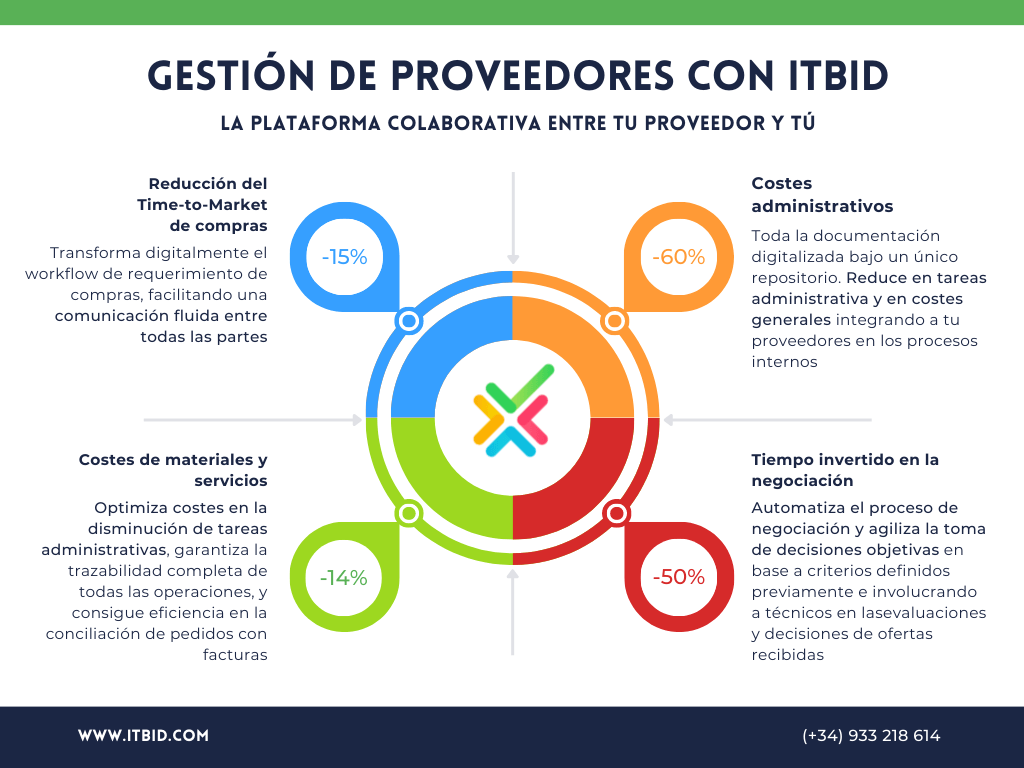
- Streamline Management with e-Procurement: Collaborative platforms like itbid make it possible to automate requests, validate suppliers, and compare bids in seconds. Discover how e-procurement is transforming purchasing.
- Promote innovation in the supply chain: prioritize suppliers that offer technological, sustainable, or disruptive solutions.
- Promote internal collaboration: integrate the procurement department with finance, operations, and CSR to ensure that decisions are aligned with the overall strategy.
Procurement Management in the Age of SRM
The future of procurement lies in digital collaboration with suppliers through SRM (Supplier Relationship Management). This type of solution centralizes data, contracts, metrics, and communication in a secure, traceable, and 100% digital environment.
An SRM such as itbid’s collaborative supplier management platform enables:
- Centralize the registration, approval, and evaluation of suppliers.
- Automate the receipt and validation of documents (ISO, insurance, ESG, etc.).
- Measure performance using scorecards and real-time risk alerts.
- Reduce manual errors and improve the traceability of expenses.
Want to see how this would work for your company?
Request a personalized demo and discover how ITBID can digitize your procurement and supplier management.
The Impact of Efficient Procurement Management
When a company transforms its procurement management into a digital, measurable, and collaborative process, the results are immediate. The following metrics demonstrate the true potential of this change:
| Indicator | Before digitizing | After optimization with SRM |
|---|---|---|
| Average purchase cycle time | 14 days | 4 days |
| Non-approved suppliers | 45% | 5% |
| Average cost per transaction | 25 € | 8 € |
| Documentary Errors | 30% | <5% |
| Estimated Total Annual Savings | — | 12–18% of operating expenses |
Conclusion: From Cost to Value
Modern procurement management is not about spending less, but about creating more value. Every euro invested must translate into efficiency, sustainability, and a competitive advantage.
Implementing a structured system, clear policies, and collaborative technology such as ITBID not only boosts internal efficiency—it also positions your company as a reliable, agile, and responsible partner in the eyes of customers and suppliers.
Let’s talk to achieve your procurement goals!
The ITBID team can help you identify areas for improvement, automate processes, and turn procurement management into a source of cost savings and sustainable growth.