

How to Choose the Ideal Procurement System for Your Company in 2025
If you’re a purchasing director or procurement manager, you know that efficiency in procuring products and services plays a major role in a company’s operational success. However, choosing the right procurement system can be a challenge, especially given today’s wide range of technological options. In this article, we’ll outline the key factors you should consider when selecting a solution that will truly boost your results in 2025 and beyond.
The Strategic Importance of a Procurement System
A procurement system is not just a tool for managing orders. It is the digital hub that connects suppliers, budgets, inventory, and key departments within an organization. Its purpose is to optimize the entire procurement cycle—from the purchase request to the final payment—by providing traceability, control, and transparency at every stage.
Digitizing the procurement process makes it possible to automate repetitive tasks, reduce human error, and improve decision-making based on real data. According to Gartner’s Global Procurement Trends 2025 report, companies that use integrated eProcurement platforms reduce administrative costs by 23% and total procurement cycle time by 30%.
In addition, a modern procurement system serves as a driver of sustainability and regulatory compliance. It enables companies to audit suppliers, monitor certifications, implement ESG (environmental, social, and governance) policies, and ensure that all operations comply with international standards.
Assess the specific needs of your business
Before investing in a new platform, it is essential to conduct an internal assessment. Every company has a different level of digital maturity and unique objectives. Therefore, precisely defining your operational needs will allow you to choose a system that truly fits your structure and processes.
Start by answering some key questions: How many suppliers does your team manage? What is the average monthly purchase volume? What level of financial control do you need over purchase orders? The answers will help you identify the essential modules and features: supplier management, automatic approvals, accounting integration, order tracking, etc.
It’s also important to assess your team’s capabilities. A highly advanced system may be of little use if your staff lacks the training or resources needed to make the most of it. In this regard, choosing a scalable platform that grows alongside your business is usually the most cost-effective option in the long run.
The key lies in the integration of the procurement system
Integration is probably the most critical factor in choosing a modern procurement system. Standalone software creates information silos and forces you to duplicate tasks. In contrast, a tool that integrates with your ERP (Enterprise Resource Planning), CRM, and accounting systems centralizes all data and improves cross-departmental collaboration.
For example, if your company uses SAP, Oracle, or Microsoft Dynamics, the procurement system should be able to automatically synchronize orders, invoices, and inventory data. This ensures that every transaction is recorded, and the finance department has a real-time view of expenses and purchase commitments.
A fully connected procurement environment also enables the use of advanced analytics. Through dashboards and customized reports, managers can identify budget variances, optimize supplier rotation, and forecast future procurement needs.
Ease of use: Adoption depends on the user experience
Ease of use is another fundamental pillar. It’s not enough to have a powerful system; it must be intuitive and accessible to the entire team. A clear interface and a minimal learning curve facilitate internal adoption and prevent resistance to change, one of the biggest obstacles in digitization processes.
The ideal system should offer automated workflows, configurable alerts, smart search tools, and a design optimized for both computers and mobile devices. Mobile accessibility, in fact, is now a strategic necessity, as it allows users to approve orders or review budgets in real time from anywhere.
In practice, a visual and collaborative work environment reduces management time by up to 40%. It also improves communication between departments by enabling comments, reviews, and approvals within the same platform.
Security and Regulatory Compliance
One of the most overlooked—yet most critical—factors when choosing a procurement system is data security. Platforms must ensure the confidentiality of financial and commercial information, as well as compliance with international standards such as the GDPR and ISO 27001.
Choosing a provider that offers secure servers, end-to-end encryption, and automatic backups is essential to prevent the risk of data breaches or loss. Additionally, the digital traceability of purchase documents provides transparency and facilitates internal and external audits.
In an increasingly regulated environment, where digitalization and business ethics are inseparable, choosing a procurement solution with clear security and compliance policies is a non-negotiable requirement for any modern organization.
Comparison of Criteria for Choosing a Procurement System
| Criterion | What to evaluate | Key benefit |
|---|---|---|
| Integration | Compatibility with ERP, CRM, and accounting tools. | Centralized data and reduced errors. |
| Automation | Automated processes for approvals, alerts, and orders. | Time savings and increased productivity. |
| Ease of use | Intuitive interface that adapts to the device. | Quick internal adoption and a shorter learning curve. |
| Security | Encryption, backups, GDPR and ISO compliance. | Data protection and business trust. |
| Scalability | Capacity for growth and customization. | Long-term technological sustainability. |
itbid: the comprehensive solution for collaborative procurement management
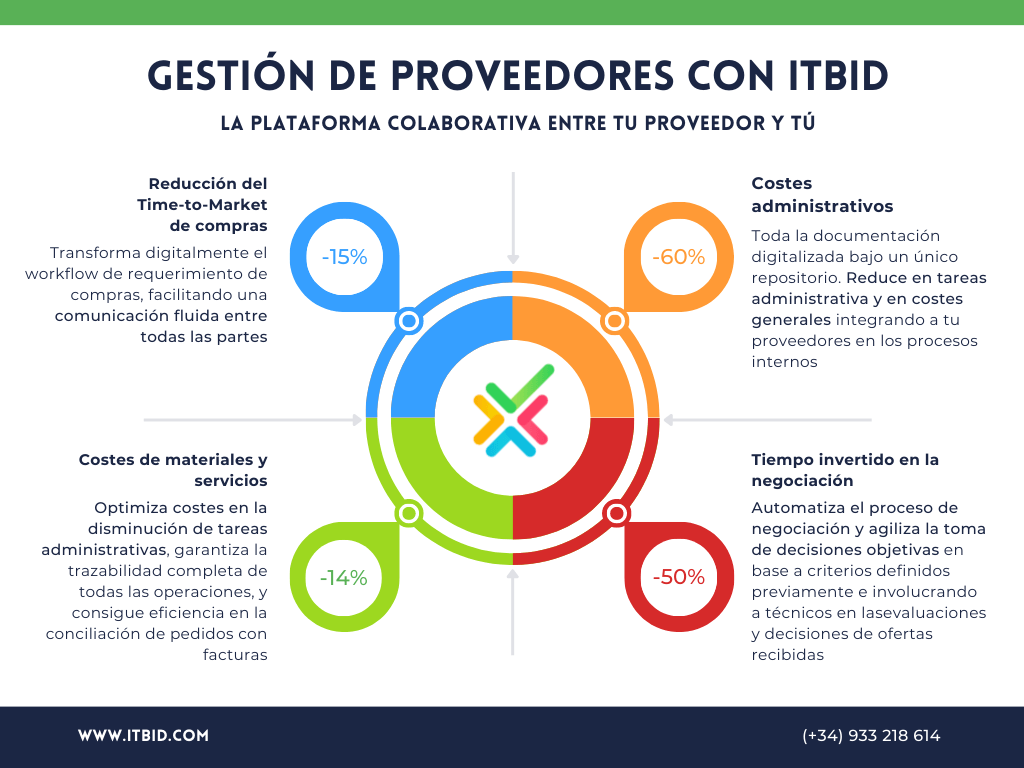
If you’re looking for a flexible, scalable, and secure procurement system, itbid is the platform designed to optimize every stage of the process. It allows you to manage suppliers, automate requests for proposals, centralize contracts, and analyze results in real time.
Its intuitive interface makes it easy for procurement and finance teams to adopt, while its modular architecture integrates easily with the leading ERP systems on the market. In addition, it includes advanced features for supplier evaluation, performance scoring, and automated reporting.
With itbid, your procurement department can work collaboratively, increase transparency, and reduce administrative time. Thousands of companies have already transformed their procurement management and achieved new levels of operational efficiency.
Request a free demo and discover how our technology can revolutionize the way you shop, manage, and do business.