

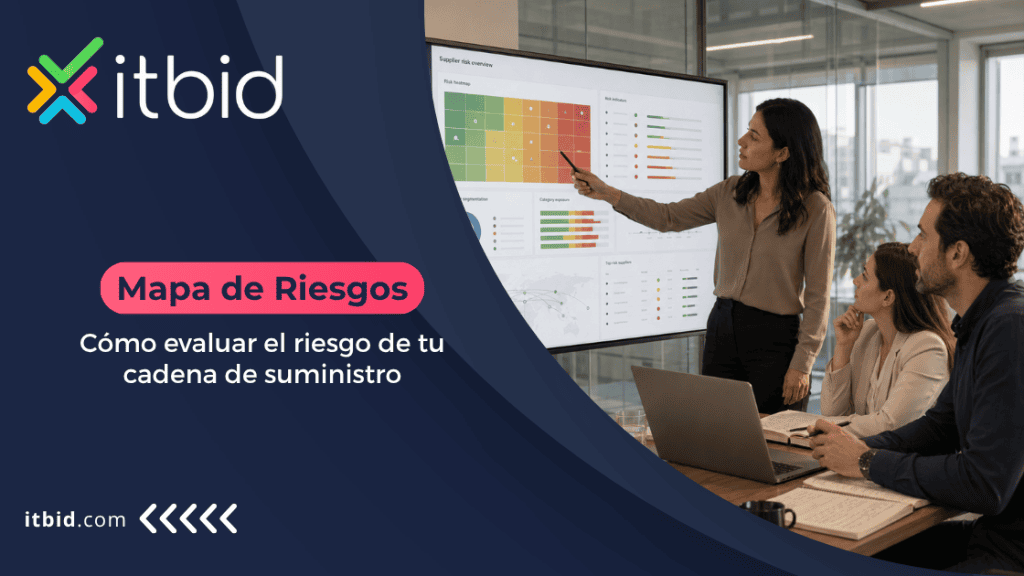
A supplier risk map classifies each supplier based on the impact and probability of failure, combining financial, operational, ESG, geographical, and cyber risks. It enables you to prioritize monitoring of critical suppliers and anticipate supply chain disruptions.
A single critical supplier that fails can stop a factory or result in breach of a customer contract. The risk map is the tool that tells you where to look first. Here’s how to build and keep it current.
What Is a Supplier Risk Map
It’s a representation that positions each supplier based on two axes: the probability that a problem will occur and the impact it would have on your business, plus the type of risk it represents.
The result is a prioritized snapshot: not all suppliers deserve the same attention.
Types of Risk: Financial, Operational, ESG, Geographical, and Cyber
- Financial: solvency, liquidity, or excessive dependence on your company as a client.
- Operational: capacity, quality, timelines, or dependence on a single point of supply.
- ESG: environmental, labor, or governance non-compliance that could affect your company reputationally and legally.
- Geographical: political instability, natural disasters, tariffs, or conflicts in the supplier’s region.
- Cyber: vulnerabilities of suppliers accessing your systems, processes, or data.
The Impact × Probability Matrix
| Probabilidad / Impacto | Low | Medium | High |
|---|---|---|---|
| High | Monitor | Manage | Critical |
| Medium | Accept | Monitor | Manage |
| Low | Accept | Accept | Monitor |
Suppliers in the “Critical” corner, with high probability and high impact, concentrate the mitigation plan. Those in the “Accept” zone barely require monitoring.
Step-by-Step to Build a Risk Map
- Inventory your suppliers and prioritize those representing the highest spending or dependence.
- Evaluate each type of risk with financial data, performance, ESG, and external context.
- Score the impact and probability of each supplier.
- Position them in the matrix to define their priority level.
A solid supplier classification makes this work much faster and more actionable.
How to Continuously Monitor Risk
Risk is not static: a solvent supplier today can face difficulties in just months. The trend in 2026 is real-time monitoring, with automatic alerts for changes in solvency, performance, or external signals.
Where Risk Data Comes From
A reliable risk map draws from internal and external sources.
- Internal Data: performance history, delays, quality incidents, non-conformities, spending concentration, and degree of dependence on each supplier.
- External Data: solvency reports, financial data, legal or sanctions alerts, ESG information, and signals from geographical or sectoral context.
The map’s strength lies in crossing both sources. A supplier may have impeccable internal performance while, at the same time, experiencing deteriorating financial condition; something you only detect by looking outside.
The more automated the collection of these signals, the more current the map will be.
Concentration Risk: The One That Hurts Most
Among all types of risk, concentration risk deserves special attention because it causes the most severe crises and, paradoxically, is the easiest to overlook.
Relying on a single supplier for a critical component, or having a supplier that generates the bulk of their business with you—inverse dependence—creates single points of failure.
If that supplier goes bankrupt, suffers a fire, or decides to raise prices, your ability to react is minimal. Identifying these concentrations and actively working to qualify secondary sources for critical items is one of the highest-impact decisions that comes from a well-constructed risk map.
How AI Changes Risk Monitoring
The major transformation of 2026 is the shift from an annual snapshot to continuous monitoring, and artificial intelligence is what makes it possible.
Instead of manually reviewing each supplier, systems automatically cross financial signals, performance data, and external indicators, and trigger an alert when something changes: a drop in credit rating, a spike in incidents, or relevant news.
This advances detection weeks or months ahead of traditional periodic review. It’s precisely the time you need to activate a Plan B before the problem catches up with you.
Continuous monitoring doesn’t eliminate risk, but it converts surprises into anticipation.
Mitigation Plan
For each critical supplier, define concrete actions:
- Qualify a secondary supply source.
- Increase safety stock.
- Strengthen contractual clauses.
- Establish contingency plans.
A map without an action plan only describes the problem; a plan manages it.
Frequently Asked Questions
How Is Supplier Risk Evaluated?
By crossing multiple types of risk—financial, operational, ESG, geographical, and cyber—and scoring each supplier based on the impact a failure would have and the probability of it occurring, to position it in a prioritization matrix.
What Is a Supplier Risk Matrix?
It’s a table that crosses the impact and failure probability of each supplier, classifying them into levels: critical, manage, monitor, or accept. It serves to prioritize where to concentrate monitoring and mitigation.
How Often Should Risk Be Reviewed?
Critical suppliers should be monitored continuously through automatic alerts. Others can be reviewed quarterly or semi-annually, and always when relevant changes in their situation occur.
Monitor Your Supplier Risk in Real Time
Discover how itbid’s supplier management and quality can help you detect risks, prioritize actions, and protect your supply chain.